This book is educational. It does not provide medical, legal, cybersecurity, procurement or investment advice. Technology capabilities and standards evolve; verify critical decisions against current primary sources.
Contents
IntroductionQuantum is already in your life
Chapter 1The quantum world without equations
Chapter 2Inside a quantum computer
Chapter 3Sensors networks and the quantum gravity frontier
Chapter 4Quantum security from PKI to PQC and QKD
Chapter 5Quantum and health from molecules to patients
Chapter 6Moving through the world quantum and AI in transport
Chapter 7AI and quantum where the comparison works
Chapter 8Who benefits from the quantum transition
Introduction
Quantum is already in your life
A practical, evidence-led guide to the science, engineering and decisions behind quantum technology.
0.1
A machine built from quantum rules
Imagine lying inside an MRI scanner. The sound is mechanical, but the information begins at the scale of atomic nuclei. A strong magnetic field slightly biases the orientation of hydrogen nuclei, radio-frequency pulses disturb that population, and receiver coils detect the signal emitted as the nuclei relax. Spatially varying magnetic fields encode position. Reconstruction software turns those signals into an image. Nothing in this description requires a quantum computer, yet none of it makes sense without quantum physics.
MRI is a useful place to begin because it prevents a common mistake: treating quantum technology as a single future machine. Quantum effects already support lasers, transistors, magnetic-resonance imaging and atomic clocks. The newer quantum technologies aim to prepare, control and read individual quantum systems with much greater precision. That added control opens three broad toolsets: computing, sensing and communication.
Reader checkpointWhat is the physical system? What is measured? What is the strongest comparison? What evidence exists today?
FIGURE 1
The quantum technology map
01Quantum computing
02Quantum sensing
03Quantum communication
Three toolsets share precise preparation, control and measurement, but solve different problems.
0.2
Three branches and one discipline
Quantum computing uses controlled interference to process information. Quantum sensing uses fragile quantum states as exquisitely responsive probes of time, fields, acceleration or gravity. Quantum communication distributes quantum states or keys and can reveal particular forms of interception. Each branch has different hardware, economics and timelines. A hospital planning cryptographic migration is not waiting for a quantum sensor; an aircraft testing an atom interferometer is not running Shor's algorithm.
The discipline shared by all three is evidence. A scientific result may be a proof, a laboratory demonstration, a field trial, a resource estimate or a product. Those categories are not interchangeable. Throughout this book we will ask four questions: What physical system carries the information? How is it controlled and measured? What benchmark represents the best classical alternative? What evidence would justify adoption?
0.3
A map for the reader
The first three chapters build the vocabulary: quantization, interference, entanglement, hardware, error correction, sensors and networks. Chapters 4 through 7 apply that vocabulary to security, health, transport and artificial intelligence. Chapter 8 asks how regions can convert science into shared prosperity. Optional technical lenses introduce equations only where they sharpen intuition. You can skip them without losing the narrative.
Quantum technology is neither magic nor a fraud. It is a demanding form of engineering built on a physical theory that has survived a century of experimental tests. Its potential is real, but usefulness depends on systems engineering, reproducible advantage, integration cost, safety and public trust.
Chapter summary
A machine built from quantum rules
Three branches and one discipline
A map for the reader
Chapter 1
The quantum world without equations
A practical, evidence-led guide to the science, engineering and decisions behind quantum technology.
1.1
Why ordinary intuition runs out
Classical physics describes falling objects, engines and planetary motion with extraordinary success. Its concepts assume that objects possess properties such as position and velocity whether or not anyone looks. At atomic scales, experiments forced a different description. Matter exchanges energy in discrete amounts; particles create interference patterns; and some properties cannot simultaneously have arbitrarily precise values.
The word quantum comes from the idea of an amount or packet. In an atom, an electron is not a tiny planet choosing any orbit it likes. The bound system has allowed energy states. When it moves between them, the energy difference is absorbed or emitted, often as a photon. A staircase is a useful analogy for allowed levels, but it stops there: quantum states are mathematical patterns, not miniature steps in space.
Reader checkpointWhat is the physical system? What is measured? What is the strongest comparison? What evidence exists today?
FIGURE 2
From possibility to measurement
01Prepare state
02Control phase
03Interfere paths
04Measure outcome
A quantum experiment is an engineered sequence, not a mysterious observation.
1.2
One detection at a time
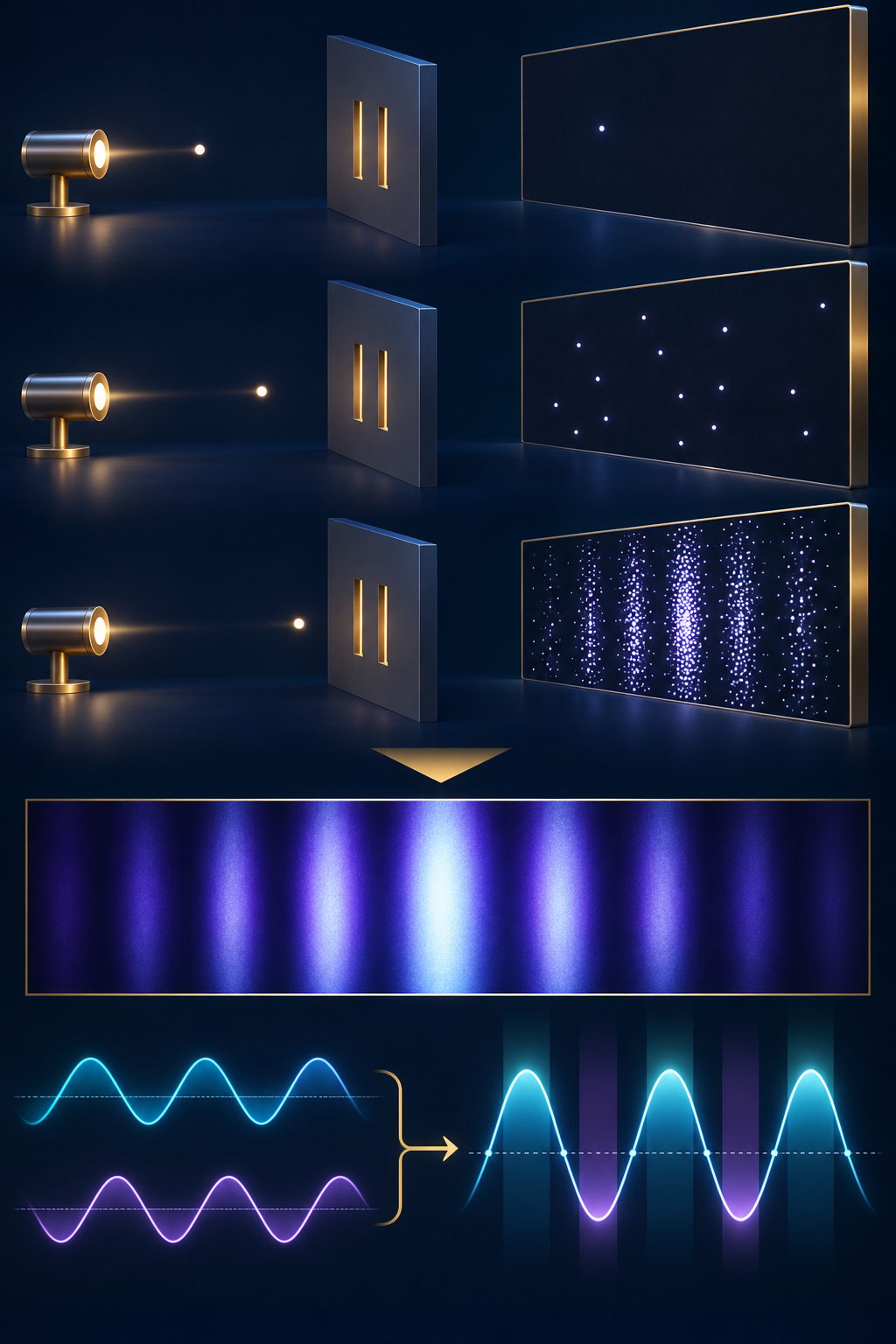
In the double-slit experiment, particles sent toward two openings arrive as localized detections. After many repetitions, the detections build alternating bright and dark bands. The probability pattern behaves as though alternatives associated with the two paths combine like waves. Where their phases align, amplitudes reinforce; where they oppose, amplitudes cancel.
The important quantity is a complex probability amplitude. Probabilities arise from the squared magnitude of the combined amplitude. That order matters: add amplitudes first, then square. If we obtain reliable which-path information, the alternatives become distinguishable and the interference changes. No conscious observer is required. Measurement is a physical interaction that leaves a record in the environment or an apparatus.
How individual detections become an interference pattern
The apparatus sends particles toward two narrow openings and records localized impacts one at a time. Across many repetitions, the detections build alternating high- and low-probability bands. The wave curves represent probability amplitudes that can reinforce or cancel; they are not literal water waves travelling through the laboratory.
1.3
Superposition is not indecision
A qubit can be represented as |psi> = alpha|0> + beta|1>, with |alpha|^2 + |beta|^2 = 1. Measurement in the computational basis returns 0 or 1 with those probabilities. The coefficients also contain relative phase, which measurement probabilities in that basis alone do not reveal. Gates change amplitudes and phases so that later alternatives reinforce a desired answer and cancel others.
A classical probability distribution and a quantum superposition can predict the same immediate 0/1 frequencies, but they behave differently under later operations. Interference exposes the difference. This is why saying that a qubit is simply 'both zero and one' is memorable but incomplete: the operational resource is coherent control of amplitudes and phase.
1.4
Entanglement and its limits
Two qubits can have a joint state that cannot be factored into separate states. In the Bell state (|00> + |11>)/sqrt(2), measurements in the same basis are correlated even though each local outcome is random. Bell tests show correlations stronger than any local hidden-variable model satisfying the relevant assumptions can reproduce.
Entanglement does not permit faster-than-light messaging. Each observer sees random local outcomes; ordinary communication is needed to compare records. Its value lies elsewhere: teleporting a quantum state when combined with classical communication, detecting eavesdropping in certain protocols, improving metrology, and linking operations in quantum algorithms.
1.5
From bits to circuits
A classical bit occupies one of two logical states. A qubit has a continuum of possible pure states, but measurement yields limited classical information. The advantage is not that one qubit stores an accessible infinity of numbers. It is that a circuit can transform a structured set of amplitudes before measurement.
The Hadamard gate creates equal-weight alternatives. Phase gates rotate relative phase. Controlled gates create correlations and entanglement. A useful algorithm arranges these operations so that the final measurement reveals a global property with fewer resources than a known classical method. Quantum speedups are problem-specific; most ordinary software will remain classical.
1.6
Quantization uncertainty and measurement
Quantization means that some measured properties of a bound system have discrete allowed values. It does not mean that all of space and time are necessarily divided into tiny pixels. An atom absorbs a photon only when the energy matches an allowed transition; the resulting spectral lines are among the clearest fingerprints of quantum structure. The uncertainty principle is also more than imperfect equipment. For pairs such as position and momentum, the quantum state itself cannot assign arbitrarily narrow distributions to both at once.
Measurement connects the mathematical state to a durable physical record. A detector amplifies a microscopic interaction into a macroscopic signal, while the surrounding environment rapidly becomes correlated with alternatives. Decoherence explains why interference becomes unavailable in ordinary large objects, although it does not by itself settle every philosophical question about why one result is experienced. The operational lesson is straightforward: quantum behaviour requires isolation when possibilities must interfere and strong coupling when information must be read.
1.7
What quantum theory does and does not claim
Quantum mechanics predicts experimental probabilities with exceptional accuracy. It does not imply that thought creates reality, that every uncertainty is quantum, or that entanglement enables telepathy. Interpretations disagree about what the formalism says reality is, but they agree on the laboratory predictions discussed in this book.
This distinction protects the subject from mysticism. A scientific quantum claim identifies a physical system, preparation, operation and measurement. It reports uncertainty and permits another team to reproduce the result. When the word quantum is used without those elements, it may describe branding rather than physics.
Chapter summary
Why ordinary intuition runs out
One detection at a time
Superposition is not indecision
Entanglement and its limits
From bits to circuits
Quantization uncertainty and measurement
What quantum theory does and does not claim
Chapter 2
Inside a quantum computer
A practical, evidence-led guide to the science, engineering and decisions behind quantum technology.
2.1
Follow a job from laptop to laboratory
A user writes a circuit in a software development kit and sends it to a cloud service. A compiler rewrites the abstract gates into operations supported by a particular processor, maps logical circuit wires to connected physical qubits and schedules pulses. Calibration data influences the mapping because qubits and couplers do not perform identically.
At the machine, classical electronics generate microwave pulses, laser sequences or voltage waveforms. The processor evolves for microseconds to seconds depending on the platform. Readout hardware converts physical signals into bits. The experiment is repeated many times because quantum measurement samples a distribution. The service returns counts, metadata and sometimes error-mitigation results. Nearly every layer except the quantum processor is classical.
Reader checkpointWhat is the physical system? What is measured? What is the strongest comparison? What evidence exists today?
FIGURE 3
A quantum job from cloud to chip
01Program
02Compile and map
03Generate controls
04Evolve qubits
05Read and repeat
Classical systems surround the quantum processor at every stage.
2.2
Superconducting circuits
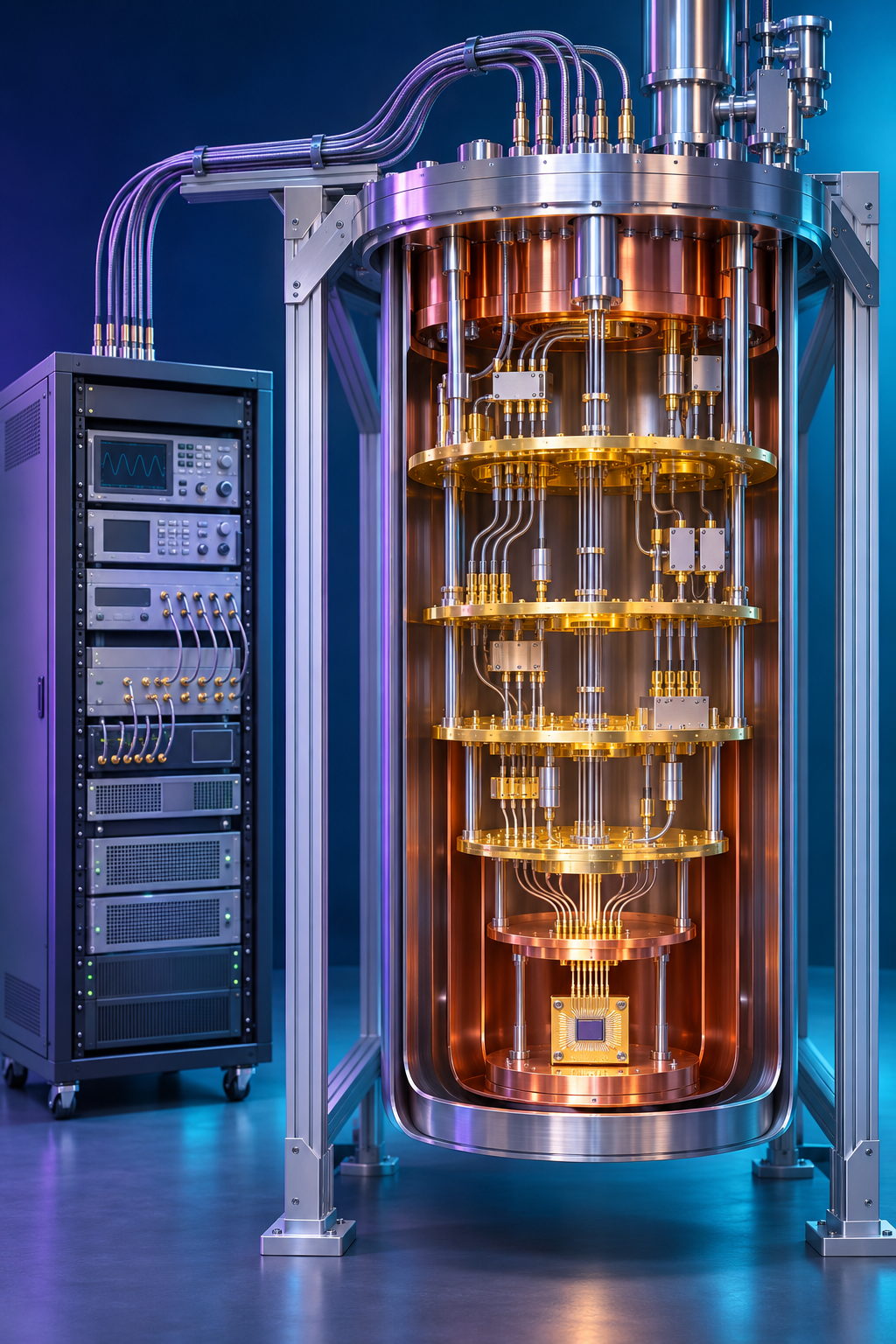
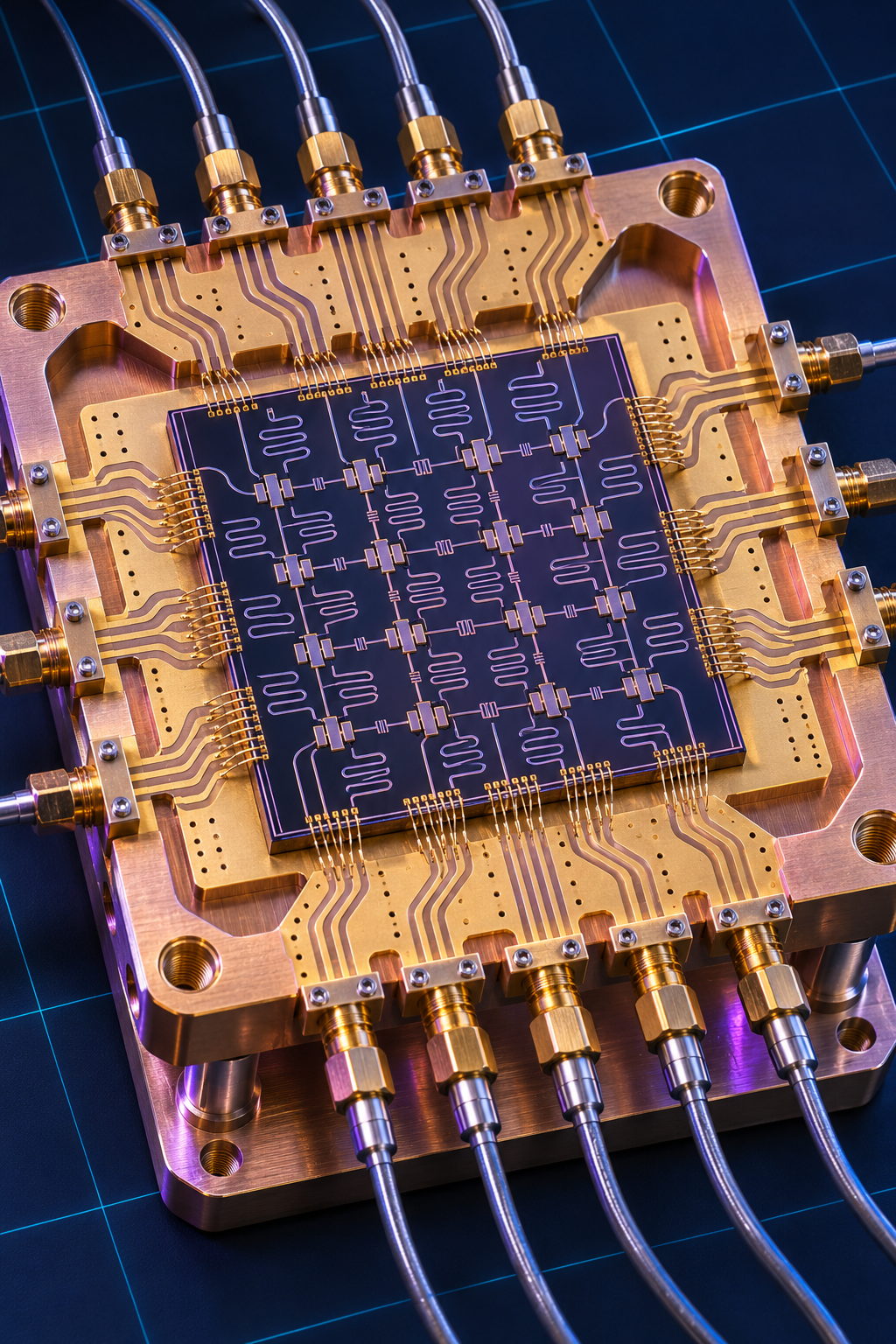
A superconducting qubit is an engineered electrical circuit cooled until resistance vanishes and collective electrical variables behave quantum mechanically. A Josephson junction, two superconductors separated by a thin barrier, supplies nonlinearity so that two low-energy states can be isolated and controlled as a qubit. Microwave pulses implement rotations; resonators help couple and read qubits.
The chip sits near the bottom of a dilution refrigerator at temperatures of only a few millikelvin. Successive temperature stages intercept heat. Attenuators reduce thermal noise on incoming lines; filters suppress unwanted frequencies; isolators protect qubits from amplifier noise; cryogenic amplifiers strengthen weak readout signals. The chandelier-like refrigerator is support infrastructure, not the quantum processor itself.
Inside a superconducting quantum computer
Conceptual cutaway showing room-temperature control electronics, the nested stages of a dilution refrigerator, microwave cabling and the small QPU package at the coldest stage. The refrigerator supports the processor; it is not itself the QPU.
2.3
Other hardware routes
Trapped-ion systems store qubits in internal states of charged atoms held by electromagnetic fields in vacuum. Lasers cool, manipulate and read them; shared motion mediates gates. Neutral-atom systems trap uncharged atoms in optical tweezers and excite them to Rydberg states to create strong interactions. Photonic systems encode information in paths, polarization, time bins or other modes and use sources, interferometers, detectors and sometimes memories. Semiconductor spin qubits use electron or nuclear spin in structures related to advanced chip fabrication.
No platform wins every metric. Ions can offer high-fidelity operations and flexible connectivity but slower gates. Superconducting circuits integrate fast control yet demand extreme refrigeration. Photons travel well but deterministic interactions and loss are difficult. Neutral atoms can form large reconfigurable arrays while gate quality, control and fault-tolerant architectures continue to develop.
2.4
A first circuit
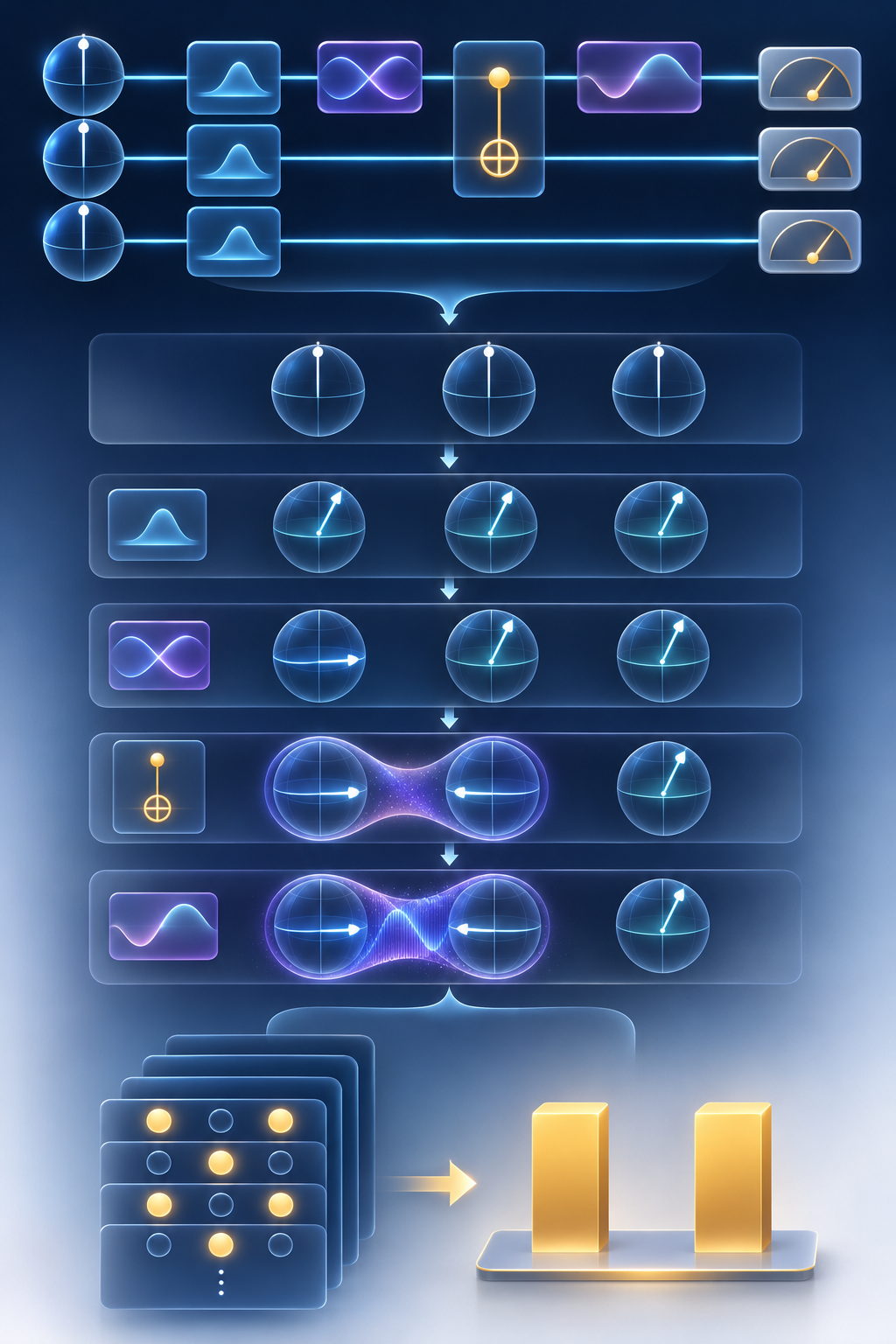
Prepare |0>, apply a Hadamard gate, and measure repeatedly. Ideally, zeros and ones appear equally often. Apply a second Hadamard before measurement and the ideal outcome becomes 0: the two operations cause amplitudes leading to 1 to cancel. This tiny experiment shows why a quantum circuit is more than a random-number generator.
For two qubits, apply a Hadamard to the first and then a controlled-NOT. Ideal measurements yield roughly equal 00 and 11 results, not all four combinations. The circuit produces a Bell state. Real hardware also returns 01 and 10 because preparation, gates and readout are imperfect.
How a quantum circuit produces a result
Conceptual sequence: initialize qubits, apply operations that control amplitudes and phase, create a two-qubit interaction, measure repeatedly and summarize the resulting classical outcomes. One measurement yields one outcome; the distribution appears across many runs.
2.5
Noise, correction and fault tolerance
Decoherence describes unwanted loss of phase relationships or energy to the environment. Control errors misrotate a state; crosstalk makes one operation disturb another; leakage moves information outside the intended two-level subspace; readout assigns the wrong bit. Error mitigation estimates cleaner expectation values without fully protecting the computation. Quantum error correction instead encodes one logical qubit across many physical qubits and repeatedly measures error syndromes without directly reading the protected information.
A fault-tolerant design ensures that one physical fault does not spread uncontrollably. Performance below an error threshold is essential, but the required overhead depends on the code, connectivity, physical error rates and target calculation. The practical scoreboard therefore includes logical error rate, logical operations, circuit depth, speed, connectivity, uptime and total cost - not qubit count alone.
2.6
Control electronics calibration and compilation
A processor is useful only when its control stack can repeatedly produce the intended operations. Arbitrary waveform generators and microwave sources shape pulses; digital-to-analogue converters set voltages; local oscillators define frequencies; timing systems synchronize channels; and field-programmable gate arrays can process readout with low latency. Calibration experiments estimate qubit frequencies, pulse amplitudes, crosstalk and measurement thresholds. Because these values drift, calibration is a continuing service rather than a one-time factory step.
The compiler works with this physical reality. It decomposes abstract gates into the device's native operations, respects connectivity, inserts routing operations and schedules pulses to avoid conflicts. A circuit that looks short on paper may become much deeper after mapping. Good system comparisons therefore disclose compilation choices and executed operations, not only the source algorithm.
The QPU package and its microwave connections
Scientifically informed editorial illustration of a superconducting QPU die, resonator-like circuit structures, wire bonds, transmission paths and microwave connectors. Exact layouts differ by architecture and manufacturer.
2.7
The fault tolerant machine as a complete system
A fault-tolerant computer needs logical qubits, repeated syndrome extraction, fast classical decoding, protected logical gates and methods for expensive non-Clifford operations such as magic-state distillation. It also needs cryogenic or optical hardware, automated calibration, compilers, workload scheduling and conventional high-performance computing.
The overhead is workload dependent. Claims that one logical qubit always requires a fixed number of physical qubits are misleading. The code distance, physical error model, connectivity, cycle time and target failure probability all matter. The correct engineering question is how many physical resources and how much wall-clock time a specified algorithm needs at a stated reliability.
Chapter summary
Follow a job from laptop to laboratory
Superconducting circuits
Other hardware routes
A first circuit
Noise, correction and fault tolerance
Control electronics calibration and compilation
The fault tolerant machine as a complete system
Chapter 3
Sensors networks and the quantum gravity frontier
A practical, evidence-led guide to the science, engineering and decisions behind quantum technology.
3.1
Quantum sensing
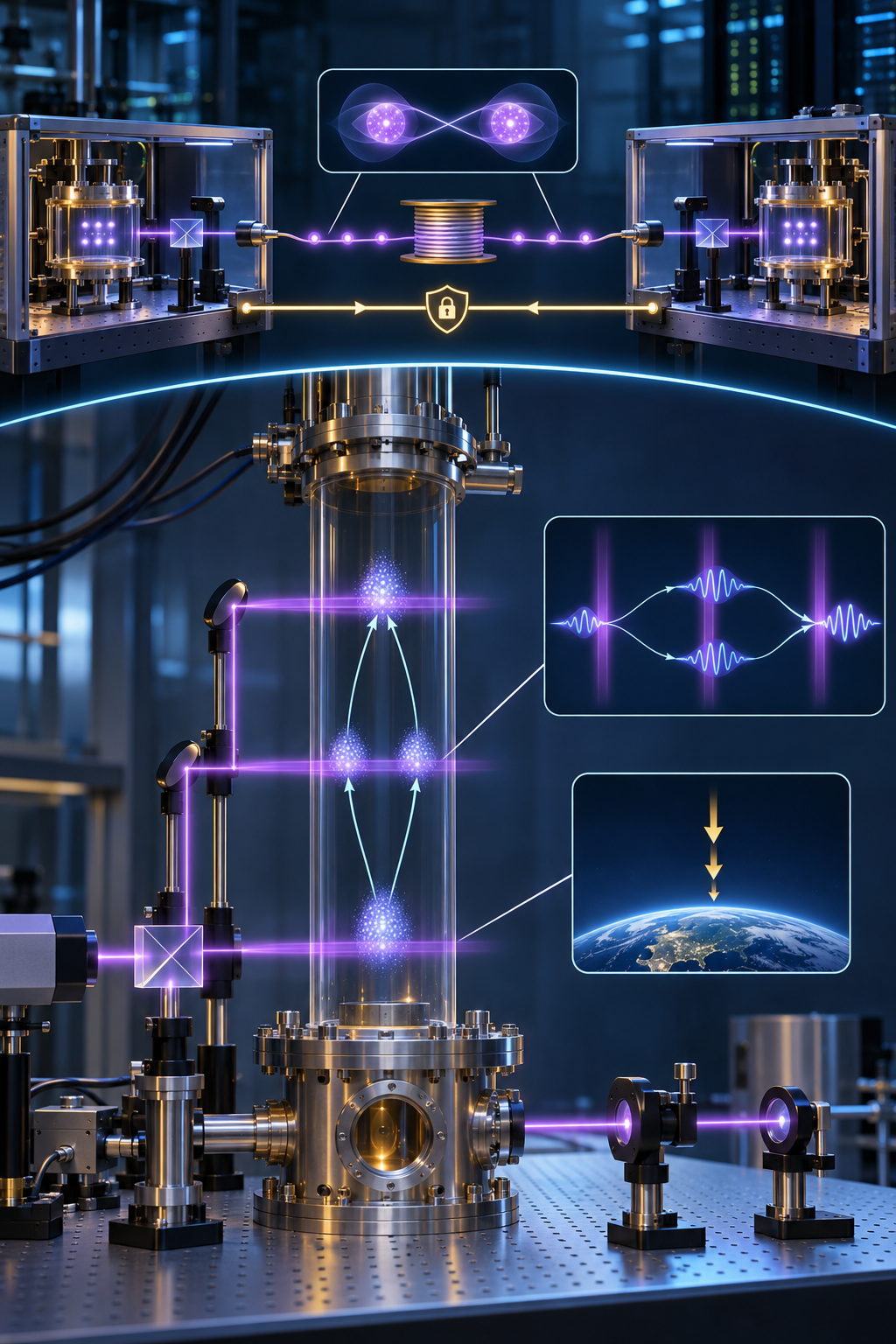
An atomic clock compares a local oscillator with an extremely stable atomic transition. Counting those oscillations produces time; comparing clocks reveals tiny frequency differences. Modern navigation, telecommunications, finance and power grids depend on precise timing. Magnetometers infer magnetic fields from their effect on spins or atomic levels. Atom interferometers split, redirect and recombine matter waves so acceleration or rotation changes their relative phase.
Sensitivity is not the only requirement. A deployable sensor must control drift, vibration, temperature, calibration, size, weight, power and data processing. Quantum enhancement is valuable only when the complete instrument outperforms an established sensor for the required environment and decision.
Reader checkpointWhat is the physical system? What is measured? What is the strongest comparison? What evidence exists today?
FIGURE 4
A future quantum network
01Entangled source
02Quantum channel
03Memory or repeater
04Remote node
05Classical message
Loss, memory lifetime, fidelity and authentication determine whether the network is useful.
Quantum sensing and networking use different physical jobs
The lower apparatus illustrates laser pulses splitting and recombining cold-atom wave packets so acceleration or gravity changes their relative phase. The upper link illustrates quantum states or entanglement distributed between nodes, alongside a separate authenticated classical channel. Quantum communication does not transmit usable information faster than light.
3.2
Networks and teleportation
Photons are natural flying qubits because they travel quickly and interact weakly with the environment, but loss grows with distance. A quantum network may need sources of entanglement, memories that hold states, frequency conversion and repeaters that extend entanglement without copying an unknown state. The no-cloning theorem prevents the simple amplify-and-forward strategy used in classical networks.
Quantum teleportation transfers an unknown state using previously shared entanglement plus two classical bits. The sender makes a joint measurement; the receiver applies a correction chosen from the classical result. Matter is not transported, and information does not travel faster than light. Teleportation is best understood as a networking primitive for moving quantum information between nodes.
3.3
QKD in perspective
Quantum key distribution uses prepared quantum states and authenticated classical communication to establish correlated key material while bounding information that an eavesdropper could have obtained under the protocol's assumptions. It does not encrypt application data by itself. Symmetric encryption, authentication, endpoint security, key management and operational controls remain necessary.
Real systems must address detector behavior, source imperfections, denial of service, distance, trusted nodes and integration. Device-independent security offers stronger theoretical guarantees but is far more demanding. QKD can be rational for selected high-value links; it is not a universal substitute for scalable post-quantum cryptography.
3.4
Where gravity meets quantum theory
General relativity describes gravity as spacetime geometry; quantum field theory describes particles and forces on a quantum stage. Both work remarkably well in their tested domains, yet they resist straightforward unification in black holes and the early universe. Experiments with atoms can test gravitational redshift, equivalence and interference while gravity acts on quantum matter. That is not automatically evidence that gravity itself is quantized.
A stronger test would demonstrate a phenomenon that no classical gravitational field coupled to quantum matter could explain, such as gravity mediating entanglement under carefully controlled conditions. Proposed experiments are extraordinarily difficult because gravitational interactions between small masses are weak and environmental decoherence can imitate or erase the signal. String theory and loop quantum gravity are major research programs, not experimentally established descriptions.
3.5
No cloning loss and quantum repeaters
An unknown quantum state cannot be copied perfectly. This no-cloning theorem follows from the linear structure of quantum mechanics and prevents the simple read-amplify-retransmit method used in classical optical networks. Direct transmission therefore faces exponential loss with distance. Trusted relays can extend key-distribution networks, but the trusted sites become part of the security model.
A true quantum repeater would distribute entanglement over shorter segments, store successful links in quantum memories and connect them through entanglement swapping. Purification or error correction may improve quality. Every element - efficient sources, low-loss conversion, long-lived memories, high-fidelity operations and synchronized control - must work together, which is why large-scale repeater networks remain a research challenge.
3.6
How to read a quantum gravity headline
A falling atom in a superposition demonstrates quantum matter responding to gravity. A highly precise clock comparison tests gravitational redshift. Neither result alone proves that the gravitational field has quantum degrees of freedom. A more discriminating experiment must exclude classical explanations and show a signature, such as mediated entanglement, that requires a quantum information carrier under clearly stated assumptions.
Readers should ask what was placed in superposition, what produced the gravitational interaction, what alternative forces were controlled, and which statistical threshold was reached. Quantum gravity is an excellent example of why measurement precision and interpretation must be separated.
Chapter summary
Quantum sensing
Networks and teleportation
QKD in perspective
Where gravity meets quantum theory
No cloning loss and quantum repeaters
How to read a quantum gravity headline
Chapter 4
Quantum security from PKI to PQC and QKD
A practical, evidence-led guide to the science, engineering and decisions behind quantum technology.
4.1
The browser padlock
When a browser connects securely, a certificate binds a public key to a domain through a chain of digital signatures. The browser validates that chain against trusted certificate authorities, checks names and validity, negotiates algorithms and establishes session keys. Symmetric encryption then protects bulk traffic efficiently. Public-key infrastructure is therefore a trust and lifecycle system, not merely one algorithm.
RSA security relies on the difficulty of factoring large integers; widely deployed elliptic-curve schemes rely on the discrete-logarithm problem. A sufficiently large, fault-tolerant quantum computer running Shor's algorithm could solve both efficiently. Grover's algorithm offers a quadratic search speedup, so symmetric cryptography is affected differently and can generally respond with adequate key sizes.
Reader checkpointWhat is the physical system? What is measured? What is the strongest comparison? What evidence exists today?
FIGURE 5
Security architecture transition
01Cryptographic inventory
02PQC-enabled PKI
03Hybrid testing
04Agile operations
05Selected QKD links
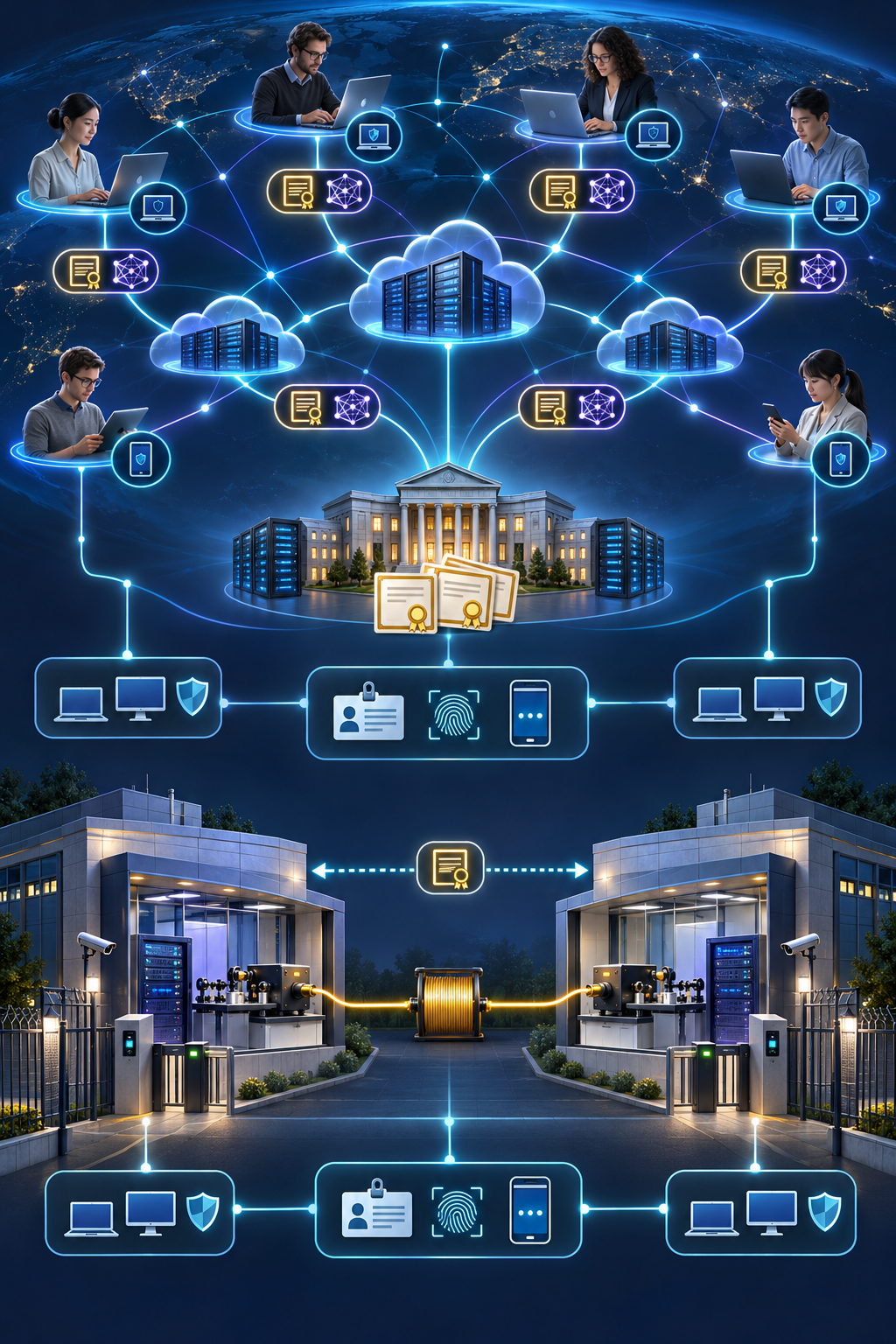
PQC modernizes scalable trust systems; QKD may complement selected links.
PQC-enabled trust at scale and QKD on selected links
The broad network represents certificates, identities, endpoints and software-based post-quantum cryptography operating across ordinary infrastructure. The specialized link between controlled facilities represents QKD equipment plus an authenticated classical channel. QKD can complement selected links, but it does not replace PKI, authentication or endpoint protection.
4.2
Harvest now decrypt later
An adversary can collect encrypted traffic today and attempt to decrypt it if capable quantum hardware appears later. The risk depends on how long the information must remain secret, how long migration will take and when a cryptographically relevant quantum computer might exist. A medical archive, state secret or industrial design may require protection longer than a routine session token.
The correct response is inventory and migration, not panic. Organizations need to find cryptography in protocols, libraries, certificates, firmware, hardware modules, supplier products and custom code. They should record data lifetimes, dependencies and upgrade paths, then prioritize systems where confidentiality or authenticity must survive longest.
4.3
PQC enters the trust system
Post-quantum cryptography runs on ordinary computers and networks. NIST's FIPS 203 specifies ML-KEM for establishing shared secret keys. FIPS 204 specifies ML-DSA and FIPS 205 specifies SLH-DSA for digital signatures. These standards address different jobs: a key-encapsulation mechanism is not a signature, and replacing one vulnerable primitive does not complete a PKI migration.
Migration touches TLS, VPNs, certificate profiles, code signing, software updates, identities, hardware roots of trust and constrained devices. New keys and signatures can be larger, implementations need side-channel resistance, and protocol combinations require interoperability testing. Crypto-agility means being able to change approved algorithms and parameters without rebuilding the organization.
4.4
A practical migration
A hospital begins with discovery: internet-facing services, medical devices, research systems, backups, archives and supplier connections. It classifies information by sensitivity and required secrecy, identifies long-lived signatures and negotiates roadmaps with vendors. A laboratory environment tests hybrid protocol options, certificate sizes, performance, monitoring and rollback. Production adoption proceeds in stages with telemetry and incident plans.
The governing question is not 'Are we quantum safe?' as a single yes-or-no status. It is whether each important information flow has an understood cryptographic dependency, an owner, a target architecture, tested implementation evidence and a funded transition date.
4.5
Where QKD fits
PQC and QKD solve overlapping but different architecture problems. PQC scales through software and standards across heterogeneous networks. QKD requires specialized endpoints and a quantum channel, plus authenticated classical communication. Its physics can reveal eavesdropping assumptions about the channel, but it does not remove endpoint compromise, malicious insiders or poor key handling.
For a public website, standardized PQC is the practical route. For a long-lived archive, protect new data with modern symmetric cryptography and migrate key establishment and signatures while considering stored-key governance. For a dedicated link between controlled facilities, QKD may be evaluated alongside PQC when cost, route, assurance model and operations justify it.
4.6
Crypto agility hybrid deployment and implementation risk
During transition, some protocols combine a conventional key-establishment method with a post-quantum KEM so that the session remains secure if at least one component is sound. Hybrid designs can reduce transition risk, but only when the combiner, negotiation, certificate handling and downgrade protection are correctly specified. They also increase message sizes and operational complexity.
Post-quantum mathematics does not prevent implementation failure. Timing leakage, power analysis, faulty randomness, memory corruption and validation mistakes can expose secrets. Cryptographic modules require tested implementations, secure update paths and inventory data that identifies algorithm, parameter, owner and dependency. Crypto-agility is the governed ability to change these elements without uncontrolled outages or silent weakening.
4.7
Quantum random numbers authentication and trust
Quantum processes can generate randomness from measurement outcomes, but a product must demonstrate that the measured entropy is genuinely unpredictable, that hardware faults are detected and that conditioning does not hide failure. Randomness supports keys and nonces; it does not repair weak authentication or compromised endpoints.
QKD also requires an authenticated classical channel. Without authentication, an attacker can impersonate both endpoints. The initial authentication secret or public-key mechanism therefore remains part of the architecture. Security is a chain of assumptions, and quantum physics strengthens only the links it actually addresses.
Chapter summary
The browser padlock
Harvest now decrypt later
PQC enters the trust system
A practical migration
Where QKD fits
Crypto agility hybrid deployment and implementation risk
Quantum random numbers authentication and trust
Chapter 5
Quantum and health from molecules to patients
A practical, evidence-led guide to the science, engineering and decisions behind quantum technology.
5.1
Mature quantum medicine
MRI is already clinical quantum technology, but its value comes from an entire system: magnets, gradients, pulse sequences, coils, reconstruction, safety procedures, trained staff and validated diagnostic pathways. Emerging quantum magnetometers may measure weak biomagnetic signals with new geometries or operating conditions, but sensitivity alone does not establish clinical benefit.
A health technology must improve a meaningful endpoint: diagnostic accuracy, time to answer, patient comfort, access, workflow or cost. It must also be robust, calibratable, cleanable, maintainable and compatible with regulation. This standard protects patients from confusing a promising sensor trace with a validated medical decision.
Reader checkpointWhat is the physical system? What is measured? What is the strongest comparison? What evidence exists today?
FIGURE 6
From molecule to patient
01Classical and AI screening
02Targeted quantum calculation
03Laboratory assay
04Clinical evidence
05Patient outcome
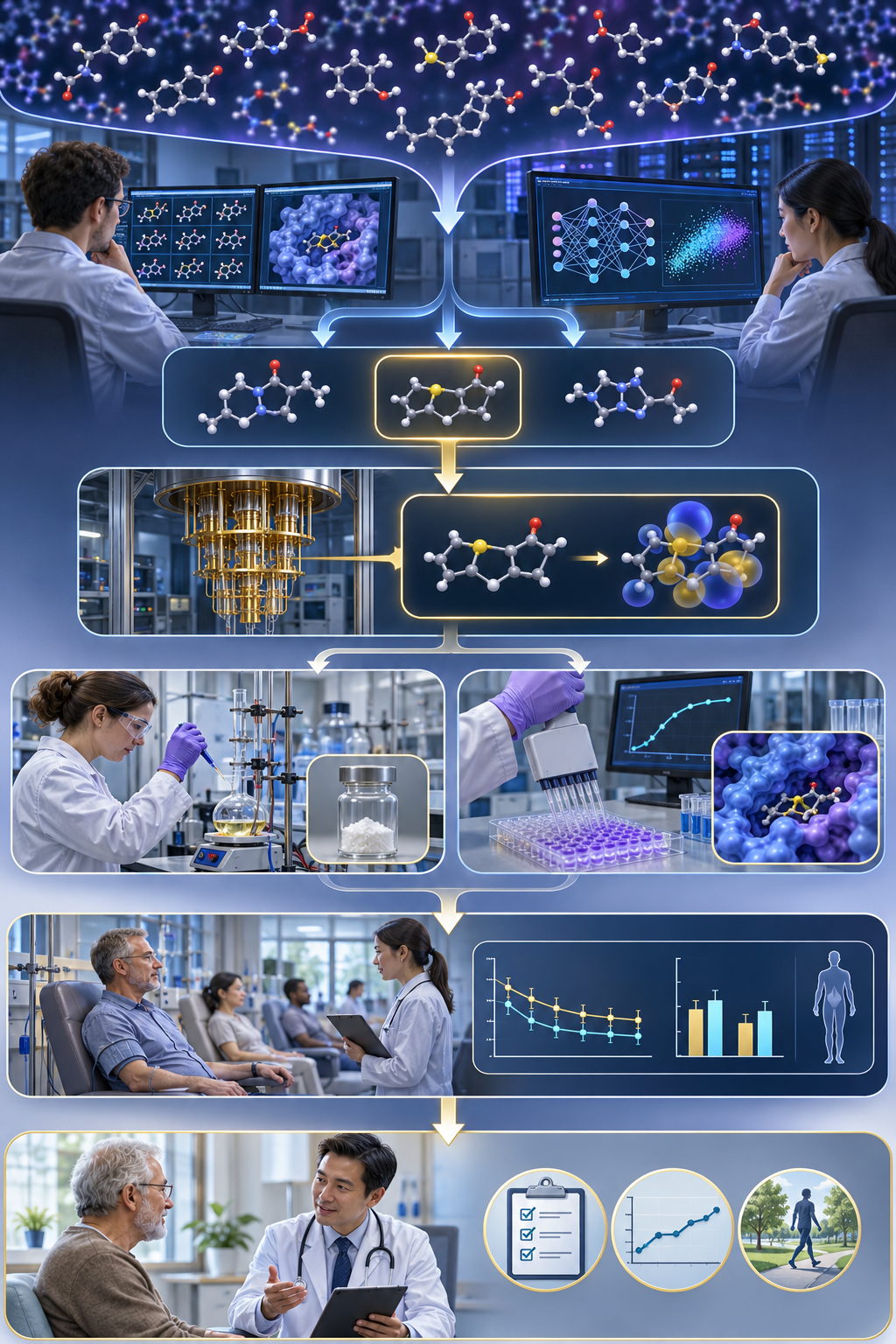
A calculation matters only when it improves a validated decision.
5.2
Why chemistry becomes hard
The electronic structure of a molecule is quantum mechanical. In principle, solving the relevant equation yields energies and properties. In practice, the size of an exact classical representation grows exponentially with the number of orbitals. Approximations such as density functional theory, coupled-cluster methods and active-space models are powerful, but some strongly correlated systems remain difficult.
A fault-tolerant quantum computer could encode fermionic states in qubits and estimate energies with algorithms such as quantum phase estimation. The word 'could' matters: state preparation, error correction, logical gates and precision can demand enormous resources. Near-term variational methods trade circuit depth for repeated measurements and classical optimization, but have not yet established broad practical advantage.
From molecular calculation to patient evidence
Classical computing and AI screen many candidates before a future quantum processor is tested on one narrowly defined electronic-structure calculation. Laboratory synthesis and assays must verify the result, followed by clinical evidence and assessment of patient benefit. A quantum calculation supports a decision; it does not replace experiments or clinical trials.
5.3
The cytochrome P450 case
Cytochrome P450 enzymes influence drug metabolism. Researchers have studied how a future fault-tolerant quantum computer might calculate challenging parts of their catalytic chemistry. A resource estimate translates a scientific target into logical qubits, circuit operations, error budgets and possible physical resources under explicit assumptions. It is an engineering map, not a clinical result.
Better electronic-structure calculations could help distinguish reaction pathways or prioritize experiments. They do not discover a medicine alone. A candidate still moves through synthesis, biochemical assays, cell and animal studies where appropriate, toxicology, clinical trials, manufacturing and regulatory review. Quantum computation earns its place only if it improves a decision in that chain.
5.4
A hybrid evidence ladder
A realistic workflow is hybrid. Classical models screen a broad chemical space. AI may prioritize candidates. High-accuracy classical or future quantum calculations examine a narrow question. Laboratory measurements test the prediction. Each stage has an uncertainty estimate and an exit criterion.
Adoption evidence should progress from mathematical correctness, to hardware execution, to comparison with the best classical method, to prospective improvement of a laboratory decision, and finally to health-economic or clinical benefit. Skipping rungs creates impressive demonstrations that do not change patient care.
5.5
From analytical validity to clinical utility
A medical sensor first needs analytical validity: does it measure the intended physical quantity accurately and reproducibly? It then needs clinical validity: does the signal reliably distinguish the condition or state of interest in the relevant population? Finally, clinical utility asks whether using the result improves care compared with current practice. These stages require prospective studies, appropriate controls, representative participants and transparent endpoints.
Regulators and health systems also examine manufacturing consistency, cybersecurity, human factors, maintenance and post-market surveillance. A quantum label does not lower this evidence threshold. It makes careful validation more important because unfamiliar mechanisms can create unrealistic expectations.
5.6
Where value could become real
Quantum chemistry could be valuable when a difficult calculation changes which molecule is synthesized or which experiment is run. Quantum sensing could matter when it detects a clinically meaningful signal with less shielding, greater comfort or better spatial resolution. Quantum-secure infrastructure could protect long-lived genomic and medical information.
Each opportunity has a measurable comparator: experiments avoided, diagnostic sensitivity and specificity, time to decision, cost per useful result, or years of confidentiality protected. These metrics connect physical performance to a patient or research outcome.
Chapter summary
Mature quantum medicine
Why chemistry becomes hard
The cytochrome P450 case
A hybrid evidence ladder
From analytical validity to clinical utility
Where value could become real
Chapter 6
Moving through the world quantum and AI in transport
A practical, evidence-led guide to the science, engineering and decisions behind quantum technology.
6.1
The autonomy stack
An autonomous system senses its environment, estimates its own state, perceives relevant objects, plans a path and controls actuators. Safety monitoring, maps, communications and human procedures surround that loop. Localization combines satellite navigation, inertial measurement, cameras, radar, lidar, wheel or air data and maps. No single sensor should silently become a point of catastrophic failure.
AI is useful in perception, anomaly detection and uncertainty estimation, but safety-critical control requires defined operating limits, verification and fallbacks. A quantum sensor enters this architecture as another measured input with a calibrated error model - not as an oracle.
Reader checkpointWhat is the physical system? What is measured? What is the strongest comparison? What evidence exists today?
FIGURE 7
Quantum sensing in autonomy
01Quantum and classical sensors
02State estimation
03AI integrity checks
04Safe planning
05Vehicle control
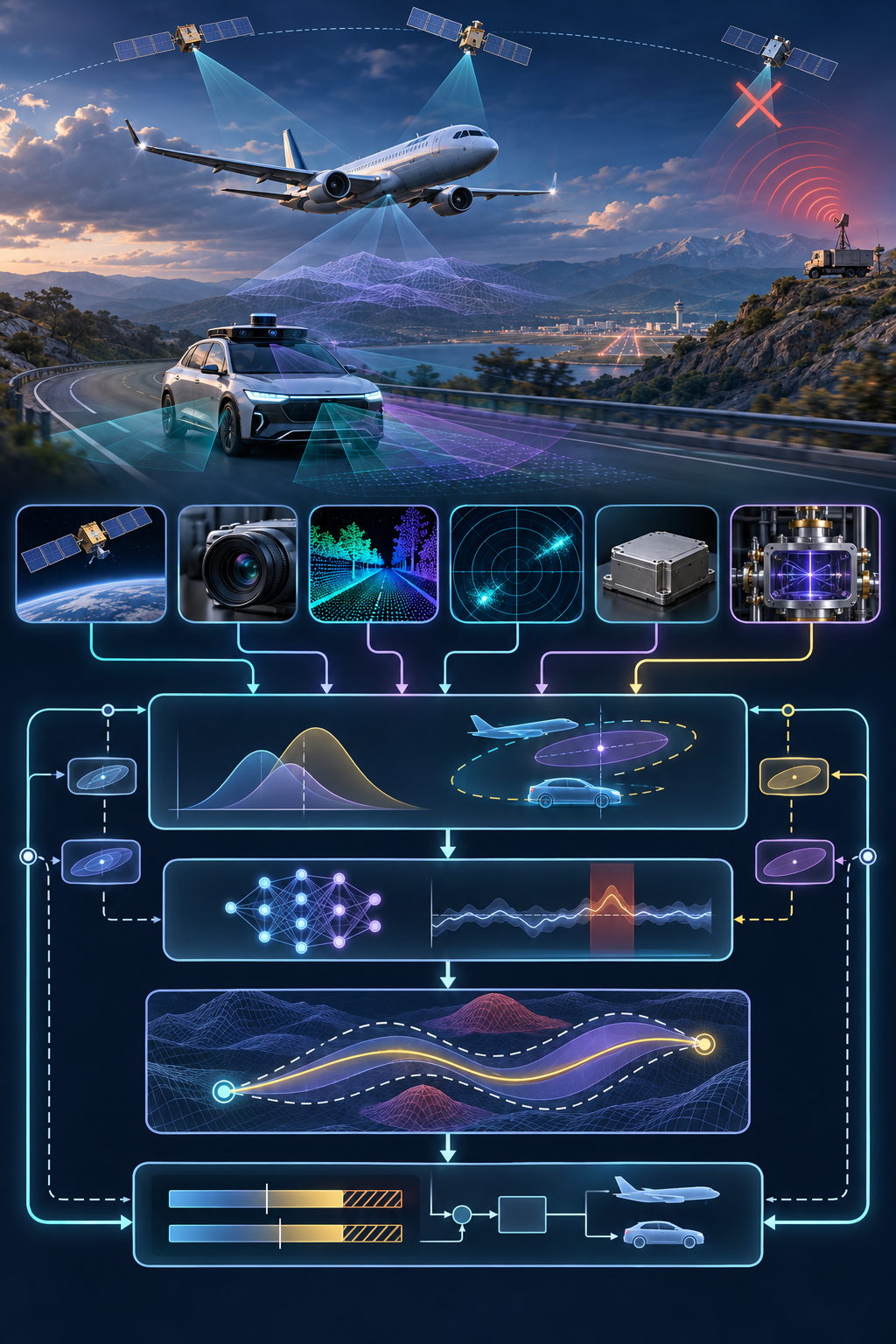
The complete architecture must quantify uncertainty and remain safe during failure.
Quantum sensing as one input in autonomous transport
Satellite navigation, cameras, lidar, radar, classical inertial sensors and a quantum inertial sensor feed a state estimate with uncertainty. AI may detect anomalies, while bounded planning and redundant control maintain safety. The jamming example shows why inertial navigation matters, but no sensor is treated as perfect or sufficient by itself.
6.2
Navigation without satellites
An inertial navigation system integrates measured acceleration and rotation. Small bias errors accumulate: integrating acceleration once produces velocity error and twice produces position error. Atom interferometers can measure acceleration or rotation by allowing matter-wave paths to acquire phase differences. Their long-term stability could help bound drift when satellite signals are unavailable or untrusted.
Flight trials demonstrate operation in a real environment, an important step beyond the laboratory. They do not by themselves prove that a system meets every navigation, size, weight, power, reliability or certification requirement. Engineers compare the complete sensor against high-grade classical inertial units under vibration, maneuvers, temperature changes and long durations.
6.3
AI as an integrity layer
A practical fusion engine can combine conventional inertial sensors, satellite observations, terrain or celestial cues and a quantum sensor. A statistical filter propagates uncertainty. Machine learning may identify unusual patterns, predict sensor health or adapt noise models, while deterministic monitors enforce physical limits and isolate suspect data.
The system should expose confidence, not just a coordinate. Testing includes spoofing, jamming, vibration, dropped measurements, calibration error and conflicting sensors. Traceable logs allow investigators to reconstruct why the system trusted an input. The AI component must be evaluated for distribution shift and failure behavior, not only average accuracy.
6.4
From vehicle to fleet
Quantum optimization research often maps routing, scheduling or charging to mathematical objective functions. Encoding a problem is not the same as solving it advantageously. Data loading, constraints, repeated sampling, classical preprocessing and queue time count toward cost. Strong classical solvers exploit structure and improve continuously.
A fair pilot freezes the business objective and dataset, selects the best available classical baseline, measures solution quality and end-to-end runtime, and includes cloud, integration and operational cost. A quantum or hybrid method is useful if it yields a decision improvement that matters to the fleet - not merely a lower value on a simplified benchmark.
6.5
Engineering qualification and certification
Transport equipment is qualified against shock, vibration, temperature, electromagnetic interference, humidity, ageing and maintenance conditions. Navigation systems also face integrity requirements: they must warn the operator quickly when their error may exceed a safe bound. A sensor that is accurate on average but occasionally fails without detection can be unsuitable for safety-critical use.
A quantum-navigation programme should therefore define an operational design domain, failure modes, redundancy, calibration intervals and an assurance case. Flight or road trials should include reference instrumentation and deliberately difficult scenarios. Certification evaluates the system, software, procedures and organization - not merely the quantum sensing element.
6.6
Autonomy needs accountable boundaries
AI can improve perception and sensor health assessment, but it must operate within an architecture that defines authority and fallback. A confidence score must be calibrated; an anomaly detector needs known limitations; and a planner must respect hard safety constraints even when a learned model recommends a different action.
The most credible quantum-AI transport system will be modest in its claims. It will show which error source is reduced, how that improvement changes a navigation or planning decision, and what happens when the quantum component is unavailable.
Chapter summary
The autonomy stack
Navigation without satellites
AI as an integrity layer
From vehicle to fleet
Engineering qualification and certification
Autonomy needs accountable boundaries
Chapter 7
AI and quantum where the comparison works
A practical, evidence-led guide to the science, engineering and decisions behind quantum technology.
7.1
Why quantum is not simply the next AI
AI spread rapidly because software could run on scalable classical infrastructure and improve many information tasks. Quantum computing depends on scarce precision hardware, error correction and problem structures that support advantage. Cloud access may make experiments easy, but it does not remove the physical constraints.
The comparison is useful when it highlights talent, platforms, standards, supply chains and the long path from research to reliable products. It misleads when it implies the same adoption curve or a general replacement for classical computing. Most future quantum applications will sit inside classical systems.
Reader checkpointWhat is the physical system? What is measured? What is the strongest comparison? What evidence exists today?
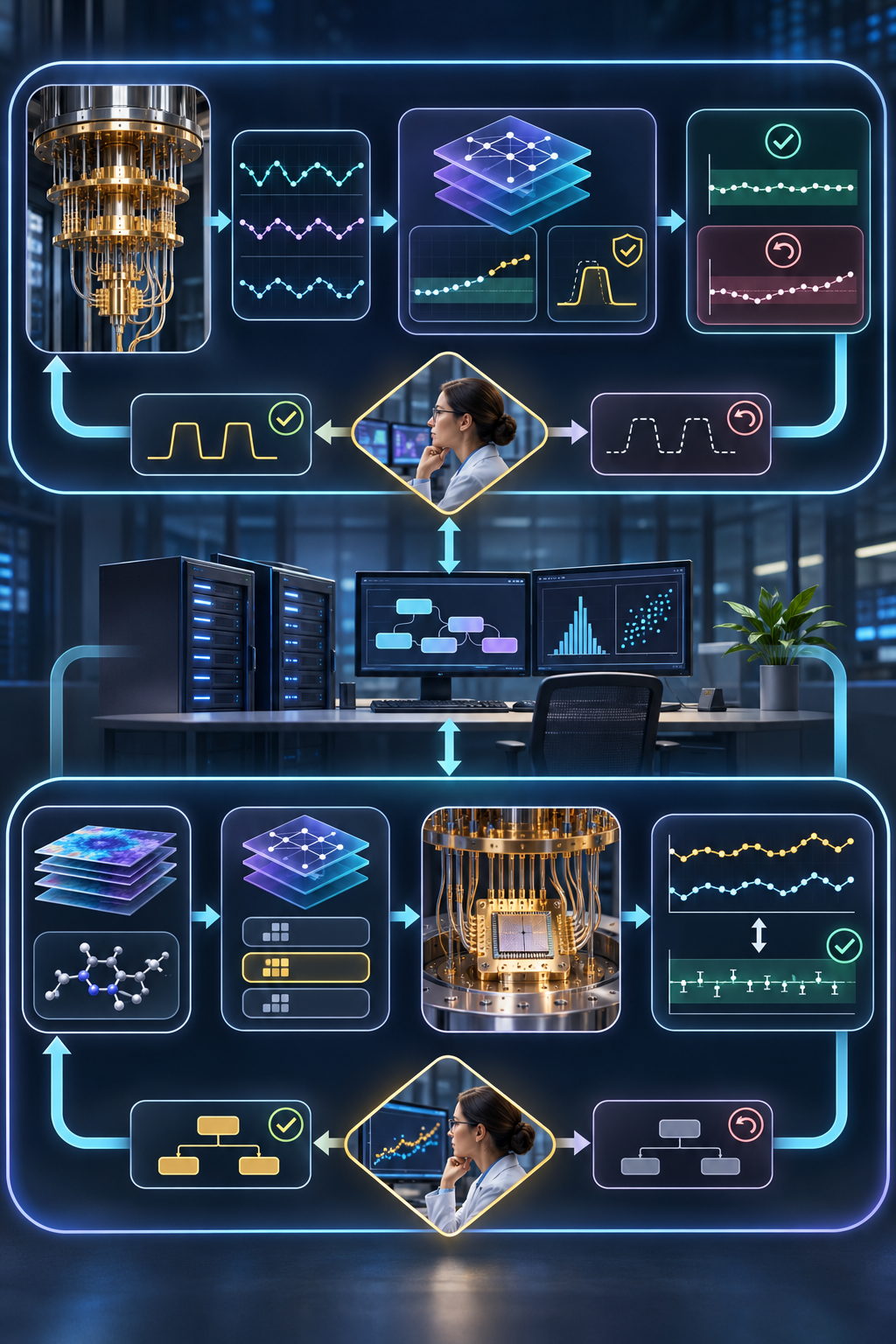
FIGURE 8
The AI quantum feedback loop
01Measure device
02AI estimates drift
03Guarded optimizer
04Apply controls
05Validate improvement
AI can tune quantum hardware when physics constraints and rollback protect the system.
7.2
AI for quantum
Quantum devices require continuous calibration. Machine learning can model drift, classify readout signals, optimize pulse parameters and help decode error syndromes. In a feedback loop, the device produces measurements, an estimator updates a model, an optimizer proposes controls, and guarded experiments test them.
The benefit is measurable: faster calibration, higher gate fidelity, longer uptime or lower logical error rate. Safety rails matter because an unconstrained optimizer can find a control setting that exploits a measurement artifact or stresses hardware. Physics-informed features, held-out validation and rollback make the loop trustworthy.
The two-way relationship between AI and quantum systems
In the upper loop, measurements from a quantum device help an AI system detect drift and propose guarded control changes that must be validated or rolled back. In the lower loop, classical and AI methods narrow a problem before a quantum processor tackles one structured subproblem; classical verification and human review remain part of the workflow.
7.3
Quantum for AI
Quantum machine learning encodes data into quantum states, applies parameterized circuits and estimates outputs from measurements. Potential advantages depend on the cost of state preparation, training, sampling and readout. If loading a large classical dataset erases the speedup, an elegant circuit is not an efficient system. Barren plateaus, noise and repeated-shot cost further complicate training.
Quantum-generated data may be a more natural target because the information begins in a quantum experiment. Even there, a useful claim requires a defined task, rigorous classical baselines and end-to-end accounting. Small demonstrations establish feasibility, not automatic advantage at scale.
7.4
The hybrid workflow
In drug research, AI can narrow candidates using existing data, classical simulation can handle routine calculations, and a future quantum processor can address a carefully selected strongly correlated subproblem. The output returns to classical uncertainty analysis and then to the laboratory. This division of labor assigns each tool to its comparative strength.
Five questions protect decision-makers from hype: What was the strongest classical baseline? Where did the data come from? Which costs were included? Does the improvement persist at realistic scale and noise? Can an independent team reproduce it? A credible advantage answers all five.
7.5
Quantum machine learning without shortcuts
A quantum model may use feature maps, parameterized gates and measurements to construct a classifier or generator. Its expressive mathematical form is not sufficient evidence of computational advantage. Training can encounter flat optimization landscapes, noise can bias gradients, and estimating an expectation value may require many circuit repetitions. Classical simulation can also be unexpectedly effective for small or structured circuits.
A valid comparison includes hyperparameter search, preprocessing, data encoding, queue time, sampling and uncertainty. It uses competitive classical models with comparable access to data. Results from tiny curated datasets should be described as demonstrations, not forecasts of industrial performance.
7.6
Why the next AI phrase persists
Both AI and quantum attract foundational research, strategic investment and platform ecosystems. Both require scarce skills and raise governance questions. This explains the phrase 'the next AI.' Yet their diffusion mechanisms differ: an AI model can often be copied and run on existing accelerators, while useful quantum computation depends on specialized physical access and error-controlled execution.
The productive lesson from AI is not to assume identical growth. It is to build evaluation capability early, create shared infrastructure, support standards and connect research to real users without promising dates that engineering cannot support.
Chapter summary
Why quantum is not simply the next AI
AI for quantum
Quantum for AI
The hybrid workflow
Quantum machine learning without shortcuts
Why the next AI phrase persists
Chapter 8
Who benefits from the quantum transition
A practical, evidence-led guide to the science, engineering and decisions behind quantum technology.
8.1
An ecosystem not a race track
Quantum value is created by a stack: fundamental research, fabrication, cryogenics, lasers, photonics, control electronics, software, cloud access, standards, education and customers willing to test early systems. Countries do not need to manufacture every layer to participate. They need an honest view of existing strengths, dependencies and public goals.
Metrics should distinguish scientific papers, patents, startups, investment, revenue, skilled jobs, exports and public benefit. Leadership in one does not guarantee leadership in another. Procurement and test facilities can be as important as grants because they help suppliers learn what reliable customers require.
Reader checkpointWhat is the physical system? What is measured? What is the strongest comparison? What evidence exists today?
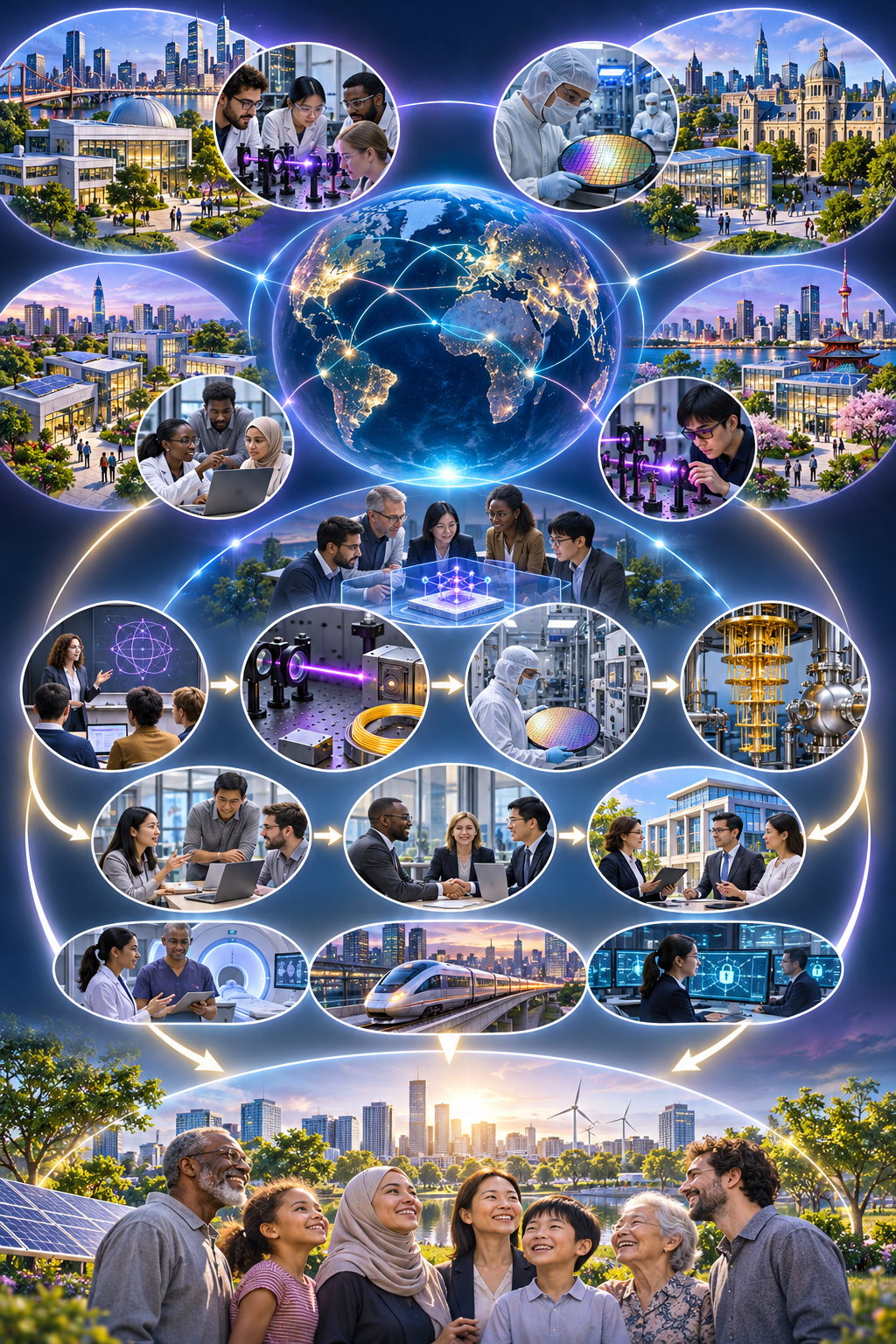
FIGURE 9
Turning science into shared value
01Research and skills
02Components and infrastructure
03Companies and standards
04Customers and procurement
05Jobs and public benefit
Regional advantage comes from an ecosystem, not a single machine.
A global quantum ecosystem creates value through connected capabilities
Regions can contribute through education, research, photonics, semiconductor fabrication, cryogenics, software, finance, procurement and customer applications. The circular flow leads from skills and components to companies, adoption and public benefit. Participation does not require every region to manufacture every layer of the stack.
8.2
Asia different routes to advantage
China has invested across communications, computing and sensing; Japan can connect quantum research with advanced materials, precision equipment and manufacturing; South Korea brings semiconductor and telecommunications capabilities; India combines a large technical workforce with its National Quantum Mission. Each route is different.
Regional cooperation can support standards, education and supply chains while competition protects strategic interests. The durable question is whether local firms and researchers own valuable knowledge, whether users can access infrastructure and whether investment addresses national problems rather than copying another country's headline projects.
8.3
United States commercialization
The United States combines leading universities, national laboratories, technology companies, venture capital and cloud platforms. That environment can move ideas into startups and customer experiments quickly. Revenue may arise from hardware access, components, software, consulting, intellectual property and government contracts well before general-purpose fault-tolerant computing exists.
Wider economic benefit requires more than company valuations. Evidence includes exportable products, productive jobs, resilient supply chains and measurable improvements for customers. Public investment should maintain basic research and shared infrastructure while procurement avoids locking institutions into premature architectures.
8.4
Europe from science to customers
Europe has deep quantum science, national programs and strengths in photonics, cryogenics, metrology and semiconductor equipment. Its challenge is often fragmentation across funding, markets and procurement. The 2025 Quantum Europe Strategy emphasizes research, coordinated infrastructure, ecosystem development, dual-use capability and skills.
The Netherlands illustrates a plausible path: university research connects to specialized suppliers, shared test facilities reduce capital barriers, and early public or industrial customers validate products. Cross-border standards and procurement can help a firm scale without recreating market access country by country.
8.5
Africa agency and access
African quantum participation should not be framed as waiting for imported machines. Researchers already organize networks, teach quantum information and contribute to theory and experiment. Near-term opportunities include postgraduate training, cloud access, photonics, sensing relevant to local priorities and cryptographic migration.
Shared laboratories and regional programs can spread expensive infrastructure. Partnerships should fund long-term faculty, technicians and institutions, not only short visits. Data governance, intellectual property and research priorities must give local participants real authority. Success means capability to choose, adapt and create technology.
8.6
The access test
A student needs affordable education, mentors and compute access. A clinician needs validated evidence and an instrument that fits care. An engineer needs components, standards and test facilities. A public official needs independent expertise, procurement discipline and a way to measure public value.
Quantum technology will be inclusive only if access is designed into training, infrastructure and governance. The final question is therefore not who reaches a single milestone first. It is who gains the capability to ask useful questions, test claims and apply the technology to problems that matter.
8.7
Supply chains standards and sovereign capability
Quantum systems depend on specialist lasers, photonics, vacuum equipment, cryogenics, microwave electronics, control software, fabrication and metrology. Mapping these dependencies reveals where a region can become a valuable supplier and where concentration creates risk. Standards for interfaces, benchmarking and security can lower adoption costs while preserving competition.
Sovereign capability does not require domestic ownership of every component. It requires enough expertise, access and bargaining power to evaluate systems, maintain critical services and make independent policy choices. International partnerships work best when knowledge, infrastructure access and intellectual property are reciprocal.
8.8
A public value scorecard
Governments should measure more than funding announcements. A balanced scorecard includes trained researchers and technicians, research quality, shared-facility use, startup survival, supplier revenue, private co-investment, customer adoption, exports and outcomes in public missions. Distribution matters: who can use the infrastructure, which regions receive jobs, and whether public institutions retain learning from pilots.
The transition will create public value when quantum capability solves an important problem better or builds durable knowledge that strengthens future choices. That standard is demanding, but it gives every region a realistic path to participate.
Chapter summary
An ecosystem not a race track
Asia different routes to advantage
United States commercialization
Europe from science to customers
Africa agency and access
The access test
Supply chains standards and sovereign capability
A public value scorecard
About the author
JKK
Jami Kiran Kumar is a global technology executive and advisor whose work spans artificial intelligence, data, cybersecurity, cloud transformation, enterprise architecture and responsible digital innovation.
His career has included senior architecture and technology leadership roles across multinational organizations and regulated industries. He has led complex transformation programs and worked with leaders on the practical questions that sit between scientific possibility and responsible adoption: value, resilience, governance, integration and accountability.
Quantum For All reflects that perspective. It explains the physics without assuming advanced mathematics, then asks what evidence a hospital, transport operator, business or public institution should demand before using a new technology.
Plain-English glossary
Amplitude
A complex number associated with a possible quantum outcome; probabilities come from its squared magnitude.
Coherence
Preservation of phase relationships needed for interference.
Decoherence
Loss of useful quantum coherence through interaction with uncontrolled degrees of freedom.
Entanglement
A joint quantum state that cannot be described as independent states of its parts.
Fault tolerance
Methods that keep errors from spreading uncontrollably during protected quantum computation.
Logical qubit
Quantum information encoded and protected across multiple physical qubits.
Physical qubit
A controllable physical system used as a basic quantum information carrier.
PQC
Post-quantum cryptography: classical algorithms designed to resist known quantum attacks.
QKD
Quantum key distribution: protocols using quantum states and authenticated classical communication to establish keys.
Qubit
A two-level quantum system used as a unit of quantum information.
Superposition
A quantum state expressed as a combination of basis states with amplitudes and relative phase.
Quantum advantage
A demonstrated practical improvement over the best relevant classical approach under fair accounting.
Selected sources and further reading
Claims should be checked against current primary literature before a new edition or operational decision. The following sources anchor the principal examples and standards discussed in this book.